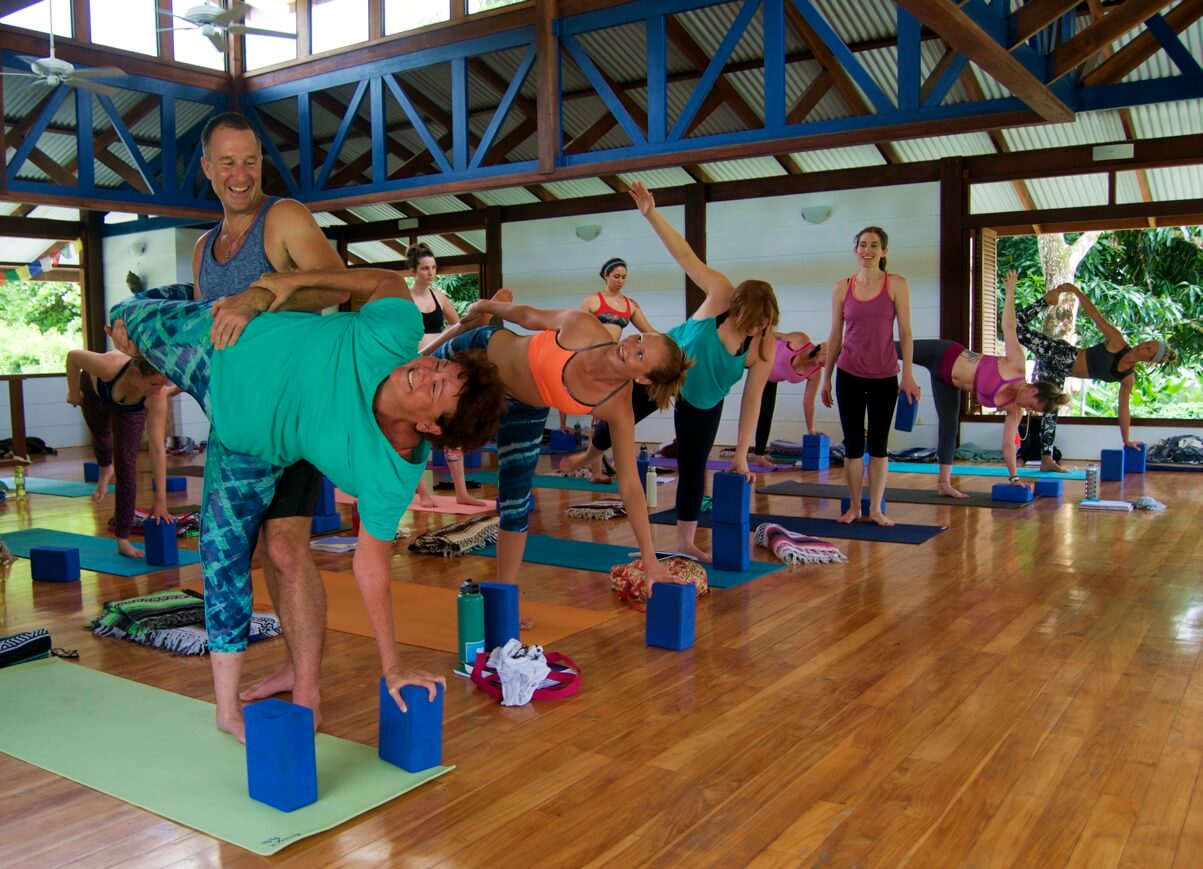

Final morning practice before early departure tomorrow. I am blessed to have experienced this jewel in the jungle, Blue Osa. I shall hold it close in mind and heart as I continue my journey…
Thank you Blue Osa!


Pass the butter ~ ~ ~ ~ This is interesting.
For those who know me intimately know my butter habits. (Yes it is a real habbit.) Many people often shake their heads in bewilderment, but in my previous life, I did so much research and reading about butter to know that people were crazy to even consider eating margarine, or even avoid butter altogether with it offered such a nourishing alternative. Many people do not know this, but buric acid (I am sure I spelled that wrong) plays a crucial role in the formation of collagen in our skin. Traveling through Tibet last summer, I had the pleasure of tasting butter tea which is widely thought of as the ‘drink of choice.’ I also saw many Tibetans use butter as a form of facial moisturizer. Anyway, enough of my rambling, please read on what I recently found…
Margarine was originally manufactured to fatten turkeys. When it killed the turkeys, the people who had put all the money into the research wanted a payback so they put their heads together to figure out what to do with this product to get their money back. It was a white substance with no food appeal so the y added the yellow coloring and sold it to people to use in place of butter. How do you like it? They have come out with some clever new flavorings.
DO YOU KNOW…the difference between margarine and butter?
Both have the same amount of calories.
Butter is slightly higher in saturated fats at 8 grams compared to 5 grams.
Eating margarine can increase heart disease in women by 53% over eating the same amount of butter, according to a recent Harvard Medical Study.
Eating butter increases the absorption of many other nutrients in other foods..
Butter has many nutritional benefits where margarine has a few only because they are added!
Butter tastes much better than margarine and it can enhance the flavors of other foods.
Butter has been around for centuries where margarine has been around for less than 100 years.
And now, for Margarine..
Very high in trans fatty acids.
Triple risk of coronary heart disease.
Increases total cholesterol and LDL (this is the bad cholesterol) and lowers HDL cholesterol, (the good cholesterol)
Increases the risk of cancers up to five fold.
Lowers quality of breast milk.
Decreases immune response.
Decreases insulin response.
And here’s the most disturbing fact…. HERE IS THE PART THAT IS VERY INTERESTING!
Margarine is but ONE MOLECULE away from being PLASTIC..
This fact alone was enough to have me avoiding margarine for life and anything else that is hydrogenated (this means hydrogen is added, changing the molecular structure of the substance).
You can try this yourself:
Purchase a tub of margarine and leave it in your garage or shaded area. Within a couple of days you will note a couple of things:
* no flies, not even those pesky fruit flies will go near it (that should tell you something)
* it does not rot or smell differently because it has no nutritional value; nothing will grow on it Even those teeny weeny microorganisms will not a find a home to grow. Why? Because it is nearly plastic. Would you melt your Tupperware and spread that on your toast?
Share This With Your Friends…..(If you want to “butter them up”)!
The digestive system is a set of organs that help process the food that we eat. It is important for the body to breakdown this food, so that the vital nutrients can be absorbed and for energy of the body to be replenished. The digestive system consists of the mouth, esophagus, stomach, small intestine, large intestine or the colon, rectum and the anus.
Like any other organ of the body, the digestive organs are also prone to many diseases and disorders, most of which are related in some way or another, to our lifestyle. Though most of the disorders are minor, like stomach upset and nausea, there are others that are chronic or intermittent.
A digestive problem of any kind can upset your schedule and make you feel miserable. A common saying goes that all ailments of the body begin from the digestive system. Usually digestive cleansing with the help of herbs, enemas or surgical tools can keep most of the digestive woes away. However, building a strong immune system and eating what’s right for you can go a long way to building a healthy digestive system. Do not let a digestive problem get you down. There is one digestive remedy that will help you stay away from any digestive disorders and that is Yoga.
Your digestive health is affected to a large extent by the food that you eat and the lifestyle you maintain. Yogic philosophy believes that for good health, digestion is extremely important.
A lot of people have found relief from their continuing problems by doing yoga for digestive system. There are many others, who, by the practice of yoga, have prevented themselves from becoming susceptible to stomach problems. Yoga not only helps stretch and tone the muscles of the abdomen, it can also stimulate the endocrine glands to make them work more efficiently. The entire digestive system thus becomes well oiled and functions smoothly to improve digestive health.
Yoga helps increase awareness of the body and its ailments. Though medicines can provide intermediate relief, yoga for digestive system means a lifetime of healthy digestion. It helps you alter your lifestyle with ease, reduce stress and other environmental factors that may cause digestive problems, and helps you attain peace and inner tranquility. Breathing exercises like Anuloma Viloma and Kapalbhatti can help increase immunity by enabling the heart to pump more blood. Stretching poses help strengthen the muscles of the digestive organs. For chronic disorders though, it is best that you to consult a yoga expert and find out what poses would be best suited for you.
Ever wonder what you’re chanting during a yoga class? Nervous about chanting the wrong thing? The Yoga Journal Guide provides translations, historical information, and audio clips for common chants.
1. AUM
The Primal Shabda
Om, actually pronounced “Aum,” is an affirmation of the Divine Presence that is the universe and is similar to the Hebrew “Amen.” There are many ways of chanting Aum, but this is an approach that will initiate you as a Shabda Yogi, one who pursues the path of sound toward wholeness and higher states of consciousness. Listen to Aum
2. Lokah Samastha
A Chant for Wholeness
Lokah samastha sukhino bhavanthu.
May this world be established with a sense of well-being and happiness. Listen to Lokah Samastha
3. Gayatri
Being Illuminated by Sacred Sound
Om bhur bhuvas svaha
Thath savithur varaynyam
Bhargo dheyvasya dhimahih
Dhyoyonah pratchodhay-yath
We worship the word (shabda) that is present in the earth, the heavens, and that which is beyond. By meditating on this glorious power that gives us life, we ask that our minds and hearts be illuminated.Listen to the Gayatri Mantra
4. Om Namah Shivaaya
Om Namah Shivaaya, Namah Shivaaya, Nama Shiva
I bow to Lord Shiva, the peaceful one who is the embodiment of all that is cause by the universe.
Listen to Om Namah Shivaaya
5. Bija Mantras
Seed Mantras
In the “seed” (bija) mantras each seed is conceived of as the sound-form of a particular Hindu deity, and each deity is in turn a particular aspect of the Absolute (Brahman). It’s said that just as a great tree resides in within the seed, so does a god or goddess reside in each bija. When we chant the bijas, we identify each syllable with the divine energy they represent.
Lam
Curve the tip of your tongue up and back, and place it on the rear section of the upper palate to pronounce a sound like the word alum without the initial a.
Base of the spine
Vam
Place the upper set of teeth on the inner section of your lower lip and begin with a breathy consonant to imitate the sound of a fast car. Pronounce the mantra like “fvam.”
Genitals
Ram
Place the tip of your tongue on the roof of the front section of the upper palate, roll the r as in Spanish, and pronounce the mantra like the first part of the word rumble.
Abdomen
Yam
Inhale audibly through your mouth, and pronounce the word hum (as in humming); allow the breath to extend beyond the resolution of the consonant.
Solar Plexus and Heart Area
Ham
Inhale noiselessly through your mouth, and pronounce the sound like the word yum (as in yummy); allow the sound along with your breath to fill your mouth and throat cavity.
Throat
Om
Inhale audibly through your nostrils, and direct the stream of air to the point between your eyebrows. Pronounce the sound along with your exhalation as a subtly audible whisper, allowing the sound and breath to resonate in the cranial area.
Point between the eyebrows
From the NY TIMES, By NICHOLAS D. KRISTOF
Hmmm. You think it’s a coincidence? Costa Rica is one of the very few countries to have abolished its army, and it’s also arguably the happiest nation on earth.
There are several ways of measuring happiness in countries, all inexact, but this pearl of Central America does stunningly well by whatever system is used. For example, the World Database of Happiness, compiled by a Dutch sociologist on the basis of answers to surveys by Gallup and others, lists Costa Rica in the top spot out of 148 nations.

That’s because Costa Ricans, asked to rate their own happiness on a 10-point scale, average 8.5. Denmark is next at 8.3, the United States ranks 20th at 7.4 and Togo and Tanzania bring up the caboose at 2.6.
Scholars also calculate happiness by determining “happy life years.” This figure results from merging average self-reported happiness, as above, with life expectancy. Using this system, Costa Rica again easily tops the list. The United States is 19th, and Zimbabwe comes in last.
A third approach is the “happy planet index,” devised by the New Economics Foundation, a liberal think tank. This combines happiness and longevity but adjusts for environmental impact — such as the carbon that countries spew.
Here again, Costa Rica wins the day, for achieving contentment and longevity in an environmentally sustainable way. The Dominican Republic ranks second, the United States 114th (because of its huge ecological footprint) and Zimbabwe is last.
Maybe Costa Rican contentment has something to do with the chance to explore dazzling beaches on both sides of the country, when one isn’t admiring the sloths in the jungle (sloths truly are slothful, I discovered; they are the tortoises of the trees). Costa Rica has done an unusually good job preserving nature, and it’s surely easier to be happy while basking in sunshine and greenery than while shivering up north and suffering “nature deficit disorder.”
After dragging my 12-year-old daughter through Honduran slums and Nicaraguan villages on this trip, she was delighted to see a Costa Rican beach and stroll through a national park. Among her favorite animals now: iguanas and sloths.
(Note to boss: Maybe we should have a columnist based in Costa Rica?)
What sets Costa Rica apart is its remarkable decision in 1949 to dissolve its armed forces and invest instead in education. Increased schooling created a more stable society, less prone to the conflicts that have raged elsewhere in Central America. Education also boosted the economy, enabling the country to become a major exporter of computer chips and improving English-language skills so as to attract American eco-tourists.
Awareness of the ida and pingala nadis can help you develop a balanced practice and clear the way for your spiritual growth.
Balancing Act - Alternate Nostril Breathing
By James Bailey
PLEASE Click here to see our upcoming Retreats and Events.
A student of the great Indian poet Kabir once asked him, “Kabir, where is God?” His answer was simple: “He is the breath within the breath.” To understand the profound implications of Kabir’s reply, we need to look beyond the physical components of breath, the oxygen, carbon dioxide, and other molecules that stream in and out with our every inhalation and exhalation. Beyond this breath, yet within it is prana, the universal vital energy that is quite literally the stuff of life.
For those of us who practice yoga, the challenge is to harness this energy so it can fuel our physical, mental, and spiritual development. To do this, we need to look deeply into the mysteries of the mind and the subtle body. Fortunately, the early practitioners of Tantra voyaged into this inner landscape, mapping the many ways energy circulates within us. Among their most important discoveries were the nadis, the vast network of energy channels that makes each individual an integrated, conscious, and vital whole.
The Sanskrit word nadi derives from the root nad , which means “flow,” “motion,” or “vibration.” The word itself suggests the fundamental nature of a nadi: to flow like water, finding the path of least resistance and nourishing everything in its path. The nadis are our energetic irrigation system; in essence, they keep us alive.
{sidebar id=2} According to many Tantric texts, the human body contains 72,000 nadis that channel prana to every cell. Some are wide and rushing; others are a mere trickle. When this system flows freely, we are vital and healthy; when it becomes weak or congested, we struggle with poor mental and physical health. The practices of hatha yoga are so effective because they strengthen the flow of prana in our bodies, invigorating the current so that it carries away obstructions that block the free flow of energy.
Because nadis like the chakras (psychoenergetic power centers), prana, and other aspects of the subtle body don’t show up under microscopes, medical science has relegated them to the realm of the merely metaphorical. But traditional yogis believe that the subtle body is real, and that understanding it and working with it complement and counterbalance the emphasis on gross physical anatomy that predominates our current yoga culture.
Three nadis are of particular interest to yogis. The sushumna (most gracious) nadi is the body’s great river, running from the base of the spine to the crown of the head, passing through each of the seven chakras in its course. It is the channel through which kundalini shakti (the latent serpent power) and the higher spiritual consciousness it can fuel rises up from its origin at the muladhara (root) chakra to its true home at the sahasrara (thousandfold) chakra at the crown of the head. In subtle body terms, the sushumna nadi is the path to enlightenment.
The ida (comfort) and pingala (tawny) nadis spiral around the sushumna nadi like the double helix of our DNA, crossing each other at every chakra. If you visualize the caduceus, the symbol of modern medicine, you’ll get a rough idea of the relationships among the ida, pingala, and sushumna nadis. Eventually, all three meet at the ajna (command) chakra, midway between the eyebrows.
The ida nadi begins and ends on the left side of sushumna. Ida is regarded as the lunar nadi, cool and nurturing by nature, and is said to control all mental processes and the more feminine aspects of our personality. The color white is used to represent the subtle vibrational quality of ida. Pingala, the solar nadi, begins and ends to the right of sushumna. It is warm and stimulating by nature, controls all vital somatic processes, and oversees the more masculine aspects of our personality. The vibrational quality of pingala is represented by the color red.
The interaction between ida and pingala corresponds to the internal dance between intuition and rationality, consciousness and vital power, and the right and left brain hemispheres. In everyday life, one of these nadis is always dominant. Although this dominance alternates throughout the day, one nadi tends to be ascendant more often and for longer periods than the other. This results in personality, behavior, and health issues that can be called ida-like or pingala-like.
Ida-like individuals have lunar, or nurturing, qualities but may lack the verve to sustain a strong yoga practice. They are full of potential, but unless they develop their pingala side may never manifest that potential in either worldly affairs or spiritual development. Pingala-like individuals have solar qualities: type A personalities, lots of creativity, abundant vitality. But unless they develop their ida side, they may lack the quietude, introspection, and receptivity necessary to yield to the grace of spiritual awakening.
Bringing ida and pingala into equilibrium is a major focus of hatha yoga is so important, in fact, that the term hatha symbolizes this balance. Although the word hatha literally means “forceful” in Sanskrit, it is composed of ha and tha, two esoteric bija (seed) mantras that have arcane meaning and power. Ha represents the solar qualities, the vital force, of pingala; tha represents the mind and the lunar qualities of ida. Balancing sun and moon, or pingala and ida, facilitates the awakening and arising of kundalini, and thus the awakening of higher consciousness. In fact, some yoga teachings hold that as long as either ida or pingala predominates, sushumna stays closed and the power of kundalini lies dormant.
The most powerful method of balancing ida and pingala is Nadi Shodhana, alternate-nostril breathing. (Literally, the Sanskrit means “nadi cleansing.”) This practice is effective because the ida nadi is directly connected to the left nostril, and the pingala nadi to the right. A few rounds of this basic pranayama technique at the end of an asana practice are an excellent way to help restore equilibrium between the two nadis and to compensate for any imbalance you may have inadvertently caused during your practice.
To practice Nadi Shodhana, sit in a comfortable meditative position. Make a fist with your right hand, then partially reextend your ring and little fingers. Lightly place the pad of the thumb on your nose just to the right and below the bridge; lightly place the pads of your ring and little fingers on the corresponding flesh on the left side of your nose. Gently pressing with the ring and little fingers to close the left nostril, exhale fully through the right. Then inhale fully through the right, close it with the thumb, release the left nostril, and exhale through it. Inhale through the left nostril, close it with the fingers, release the right nostril, and exhale through it. This completes one round of Nadi Shodhana.
In addition to using Nadi Shodhana, you can experiment with using the asanas themselves as a method of balancing ida and pingala. At the beginning of a practice, sit and observe your breath to see which nostril and, hence, which nadi is dominant. (If you can’t tell, try a few rounds of alternate-nostril breathing-it should be immediately clear which side is freer and which feels more inhibited). If the left nostril dominates, ida is in charge, and you might consider focusing your attention on invigorating asanas such as backbends, standing poses, inversions, and twists to engage the pingala nadi. If the right nostril dominates, the cooling, calming energy of seated poses and forward bends might be most beneficial.
You can also bring awareness of ida and pingala into any asana practice by pausing between poses to notice which nadi dominates your breathing. Notice your mind-states as well; you will find they closely correlate with which nadi is ascendant. Are you agitated and active (pingala-like) or calm and receptive (ida-like) Through this checking-in process, you can begin to identify which poses activate one nadi or the other, and which are particularly effective for you, at least in creating physical and emotional equilibrium. You’ll also be developing your awareness, deepening your practice, and clearing the way for your spiritual growth.
This Book recently came across my desk from the Author, who is a Hot Nude Yogi living in Texas. It is a brilliant book that shows the reader and sincere seeker how to get in touch with their body. The book is filled with beautiful pictures.
You may watch a clip on this book by clicking here.
More about the book…
Body Brilliance:
Mastering Your Five Vital Intelligences
By Alan Davidson
Photography by Victoria Davis
This book is a warm, funny, encouraging, compassionate and deeply personal guide to waking your spirit fully in your body. It engages your “five essential intelligences”—physical, mental, emotional, moral and spiritual—and develops them fully. You feel a high level of energy when your potential is being fully expressed in one of these areas; it’s important to your happiness to identify and improve the areas in which your energy feels low or weak.
Body Brilliance is filled with inspiring stories. It tells the surprising details of people who exemplified peak development in one form or another: Olympians Jesse Owens and Wilma Rudolph for physical intelligence; Albert Einstein for mental intelligence, and Rumi and his teacher Shams for spiritual intelligence. It provides powerful yet simple ways in which you can fully engage each level, by finding the wisdom that your body is trying to communicate with you—and then living that wisdom in powerful experience through your body. It teaches you to pay attention to your unique individual patterns, listening deeply to your body’s messages.
Body Brilliance is also full of practical exercises to awaken each level, and to encourage you to find your personal levels of peak expression in that domain. When you wake up fully in your body, and harmonize all five layers, you discover a result that is more than the sum of the parts; you fall deeply in love with being alive, and infatuated with being fully present in your life.
Greetings from Paradise and Happy New Year!
Construction is rapidly nearing completion and we are now booking both group and individual retreats, with our first retreat scheduled for January 31, 2010. So if you are looking for a get-away, come join us and experience everything that IS Blue Osa! We still have some availability for this year, and are accepting reservations for 2011.
We have also uploaded new photos in our Resort Overview section.
Blue Osa was created to provide for our guests and visitors all of the above, and more. Located on one of the most beautiful, secluded jungle beaches on Costa Rica’s Osa Peninsula (which ‘National Geographic’ Magazine once famously labeled “the most biologically intense place on Earth”), we at Blue Osa invite you to come join us on either a Personal Retreat, or a restful beach holiday. Bring a group of clients or friends and qualify for our group rates. Bring your spirit and your sense of adventure, and leave the rest to us as you enjoy and share a magical week, here at Blue Osa.
We look forward to hearing from you!
Shanti & Pura Vida!
Aaron Star
www.blueosa.com
At Blue Osa, we have been very blessed to have very dedicated and hardworking men be apart of our growth and community, and the building of this beautiful sanctuary. Without them this project would obviously not have been able to take place, and more, it would not have been able to be completed on time.


Mohandas Karamachand Gandhi, one of the most influential figures in modern social and political activism, considered these traits to be the most spiritually perilous to humanity.
Wealth without Work
Pleasure without Conscience
Science without Humanity
Knowledge without Character
Politics without Principle
Commerce without Morality
Worship without Sacrifice
|
Peace will not come out of a clash of arms but out of justice lived and done by unarmed nations in the face of odds.
Democracy and violence can ill go together.
Evolution of democracy is not possible if we are not prepared to hear the other side.
A coward is incapable of exhibiting love; it is the prerogative of the brave.
Hatred ever kills, love never dies; such is the vast difference between the two.
What is obtained by love is retained for all time. What is obtained by hatred proves a burden in reality for it increases hatred.
Non-cooperation with evil is a sacred duty.
Nonviolence is the greatest force at the disposal of mankind.
It is mightier than the mightiest weapon of destruction devised by the ingenuity of man
The weak can never forgive.
Forgiveness is the attribute of the strong.
What kind of victory is it when someone is left defeated?
You must be the change you wish to see in the world.
It may be long before the law of love will be recognized in international affairs. The machinery’s of government stand between and hide the hearts of one people from those of another.
To forgive is not to forget. The merit lies in loving in spite of the vivid knowledge that the one that must be loved is not a friend.
You assist an evil system most effectively by obeying its orders and decrees. An evil system never deserves such allegiance. Allegiance to it means partaking of the evil.
A good person will resist an evil system with his or her whole soul.
Nonviolence is not a garment to be put on and off at will.
Its seat is in the heart, and it must be an inseparable part of our being.
Violent means will give violent freedom.
However much I may sympathize with and admire worthy motives, I am an uncompromising opponent of violent methods even to serve the noblest of causes.
Man and his deed are two distinct things. Whereas a good deed should call forth approbation, and a wicked deed disapprobation, the doer of the deed,
whether good or wicked always deserves respect or pity as the case may be.
Hate the sin and not the sinner is a precept which though easy enough to understand is rarely practiced, and that is why the poison of hatred
spreads in the world.
Nonviolence and cowardice are contradictory terms. Nonviolence is the greatest virtue, cowardice the greatest vice. Nonviolence springs from love, cowardice from hate. Nonviolence always suffers, cowardice would always inflict suffering. Perfect nonviolence is the highest bravery.
Nonviolent conduct is never demoralizing, cowardice always is.
Destruction is not the law of humans. Man lives freely only by his readiness to die, if need be, at the hands of his brother, never by killing him. Every murder or other injury, no matter for what cause, committed or inflicted on another is a crime against humanity.
Man’s nature is not essentially evil. Brute nature has been known to yield to the influence of love. You must never despair of human nature.
It is the law of love that rules mankind. Had violence, i.e. hate, ruled us
we should have become extinct long ago. And yet, the tragedy of it is that the so-called civilized men and nations conduct themselves as if the basis of society was violence.
Power is of two kinds. One is obtained by the fear of punishment and the other by acts of love. Power based on love is a thousand times more effective and permanent then the one derived from fear of punishment.
Whether humanity will consciously follow the law of love, I do not know.
But that need not disturb me. The law will work just as the law of gravitation works, whether we accept it or not. The person who discovered the law of love was a far greater scientist than any of our modern scientists. Only our explorations have not gone far enough and so it is not possible for everyone to see all its workings.
It is good to see ourselves as others see us. Try as we may, we are never able to know ourselves fully as we are, especially the evil side of us. This we can do only if we are not angry with our critics but will take in good heart whatever they might have to say.
Gandhi was once asked what he thought about western civilization. His
response was: “I think it would be a good idea.”
For more reading…